
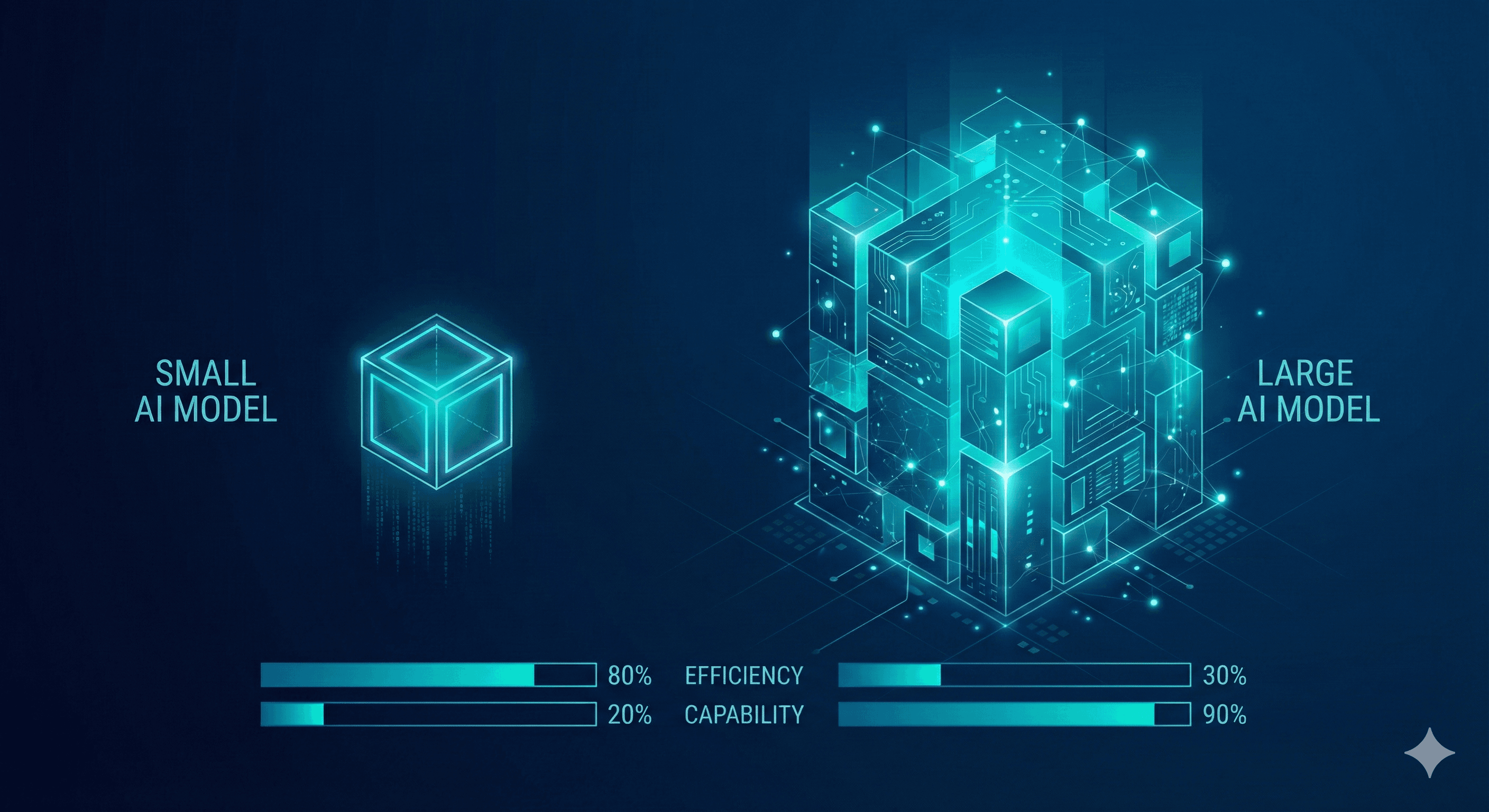
The AI industry loves its arms race. Every few months, a new "largest model ever" makes headlines. Parameters climb into the trillions. Training costs hit hundreds of millions.
But here's what the headlines miss: for most business applications, bigger isn't better.
The Quiet Revolution#
While tech giants compete for the largest language model crown, enterprises are discovering something counterintuitive. Smaller, specialized AI models are outperforming their massive counterparts for real-world tasks.
AT&T's Chief Data Officer Andy Markus puts it directly: fine-tuned Small Language Models (SLMs) will be "the big trend" for mature AI enterprises in 2026. The reason? Cost and performance advantages that make practical sense.
What Makes SLMs Different#
A typical Large Language Model (LLM) like GPT-4 has hundreds of billions to over a trillion parameters. A Small Language Model might have 7-10 billion. The difference isn't just size—it's approach.
SLMs are purpose-built. Instead of knowing a little about everything, they know a lot about your specific domain. In healthcare, a fine-tuned 7-billion parameter model called Diabetica-7B actually outperformed GPT-4 on diabetes-related medical tests.
That's not a fluke. It's the fundamental advantage of specialization.
The Business Case#
5x Faster Responses#
Every query to a massive LLM activates its entire parameter set. The result? GPT-4 Turbo with its trillion parameters runs about five times slower than an optimized 8-billion parameter model. For customer-facing applications, that speed difference is everything.
Dramatically Lower Costs#
Running enterprise-scale LLMs requires expensive GPU clusters and significant infrastructure investment. SLMs can run on standard CPUs, smaller GPUs, or edge devices. The infrastructure savings alone often justify the switch.
Your Data Stays Yours#
Most organizations can't justify the cost of self-hosting LLMs. This forces them to send sensitive data to external vendors—a non-starter in regulated industries like healthcare and finance. SLMs change that equation entirely.
Weeks, Not Months#
Deploying new LLM capabilities typically takes months of fine-tuning through reinforcement learning. Organizations can spin up new SLM capabilities in days or weeks, supporting rapid iteration.
When SLMs Make Sense#
SLMs excel when:
- Your domain is defined — customer support, legal document analysis, medical records
- Speed matters — real-time applications, customer interactions
- Data privacy is critical — healthcare, finance, legal
- Budget constraints exist — most businesses, frankly
- You need quick iteration — testing new AI capabilities fast
When to Still Use LLMs#
LLMs remain the right choice for:
- Open-ended creative tasks requiring broad knowledge
- Complex reasoning across multiple domains
- General-purpose chatbots handling unpredictable queries
- Research and exploration where breadth matters
The 2026 Reality Check#
This year is what investors call the "show me the money" year for AI. Enterprises need to demonstrate real ROI on their AI spend. Countries need productivity gains to justify infrastructure investment.
In this environment, the practical choice often isn't the biggest model—it's the right-sized one.
What This Means for Your Business#
If you're evaluating AI automation, consider:
- Define your use case precisely — the clearer your domain, the more SLMs make sense
- Calculate the total cost — including infrastructure, not just API calls
- Consider data sensitivity — can you send your data to external vendors?
- Think about iteration speed — how quickly do you need to deploy improvements?
The most sophisticated AI strategy isn't using the biggest model. It's matching the right model to the right problem.
Curious whether SLMs or LLMs make more sense for your automation needs? Book a discovery call to discuss how Digital FTEs can leverage the right AI approach for your specific use case.